How to Tell if Your Snowmobile Has AC or DC Power (Before Installing LEDs)
Before upgrading to snowmobile LED headlights, it’s critical to know whether your machine runs on AC or DC power. Installing LEDs on the wrong type of electrical system can lead to flickering, failure, or no light at all.
Here’s how to check — and what to do if your sled needs a rectifier.
✅ Why It Matters for LED Headlights
Unlike halogen bulbs, LED headlights require DC power to operate correctly. Some snowmobiles—especially older models—still use AC power, which can cause major issues if not corrected before installation.
Common problems when running LEDs on AC:
- Flickering or pulsing headlights
- Dim output at idle
- Shortened bulb lifespan
- No light output at all
To protect your upgrade and get full performance, always check your power type first.
🔧 How to Check with a Multimeter (Step-by-Step)
You’ll need:
- A basic multimeter
- Access to your headlight wires or plug
- Your snowmobile running or turned on
Step-by-step guide:
- Set your multimeter to DC voltage (V⎓)
- Start your snowmobile and let it idle
- Probe the power and ground wires at your headlight plug
- If the voltage reads around 12–14V and stays stable, your system is DC
- If it reads 0V or jumps wildly, switch to AC voltage (V~)
- Test again — if you now see 12–15V AC with fluctuating readings, your sled is likely AC-powered
💡 If your multimeter spikes and drops as you rev the engine, that’s another sign of AC power
📩 Not sure? Contact us here and we’ll help confirm your sled’s setup.
⚠️ What Happens If You Install LEDs on AC Power
If you skip the power test and install LED headlights on an AC-powered system, you might experience:
- Constant flickering
- No light at all when the sled is idling
- Surges that can damage your LED driver
- A much shorter lifespan for the bulb
To fix this, you’ll need a rectifier to convert your sled’s output from AC to clean, LED-safe DC.
📊 Quick Chart: AC vs DC Power by Snowmobile Brand

📝 Note: This chart is a general guideline. We recommend testing your specific year and model to be certain.
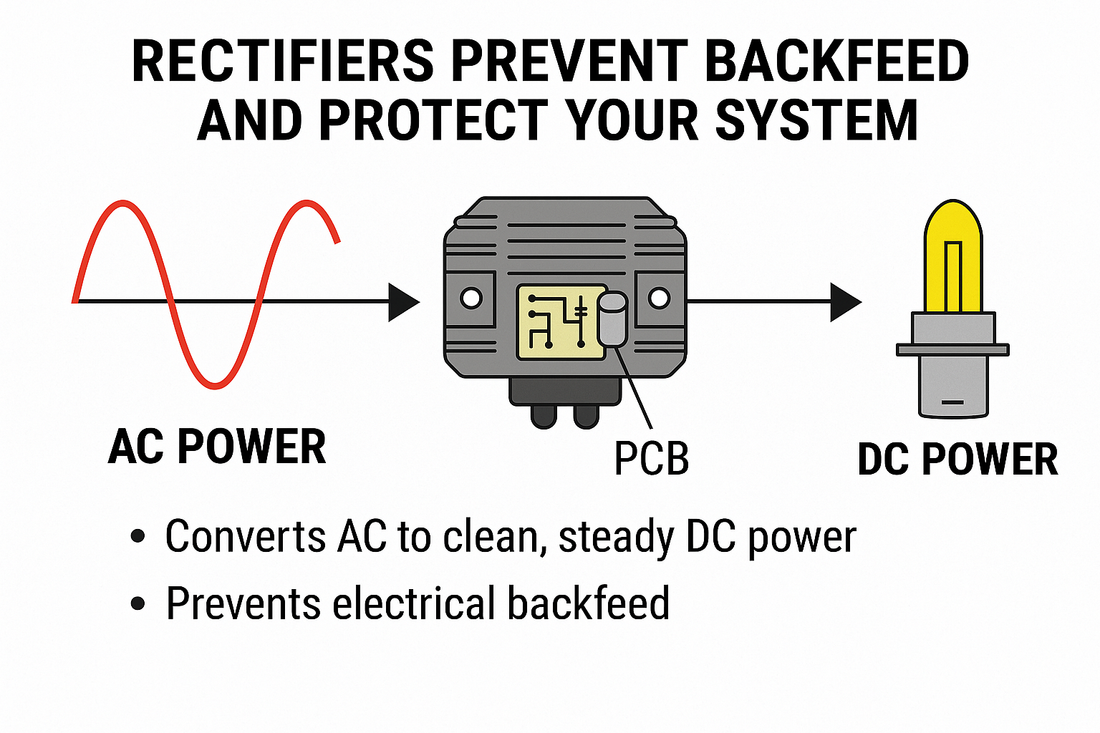
🔌 Rectifiers Prevent Backfeed and Protect Your System
If your sled uses AC power, simply adding an LED isn’t enough — you need the right AC-to-DC rectifier to protect your electrical system.
Diagram: How a rectifier converts AC to DC power and prevents backfeed to protect your LEDs.
Our LEDPowersport rectifiers:
- ✅ Convert AC to clean, steady DC power
- ✅ Prevent electrical backfeed, allowing current to flow in only one direction to the bulb
- ✅ Include a PCB and internal capacitor for voltage smoothing and system protection
This helps protect your LED bulb and snowmobile wiring for long-term performance.
💡 What to Do If Your Sled Has AC Power
If your snowmobile uses AC power:
- Add a plug-and-play rectifier (sold separately)
- Check polarity after rectifier install
- Use gloves when installing LEDs to prevent chipset contamination
📩 Message us with your year/make/model and we’ll make sure you get the right setup.
🚀 Ready to Upgrade?
Browse our snowmobile-specific kits, including the 130W High Power Series with unmatched trail visibility:
Thinking about SII Company for your LED headlights?
Before you decide, see how they stack up against LEDPowersport™ in warranty, beam quality, shipping speed, and real-world performance.
2 comments
Brian — thanks for the detailed comment. This is a great question and you’re clearly chasing the right issue.
You’re correct that this is a regulation problem, but it’s important to separate protecting the headlights from fixing the root cause.
On the 2006 Arctic Cat F6, the lighting circuit is unregulated AC. When electric start is added, the system can no longer properly dump excess stator output at higher RPM. The result is system over-voltage, not just stray AC ripple. That’s why you’re seeing:
• Headlights and brake lights blowing at higher RPM
• AC voltage showing at the battery
• Hand warmers getting dangerously hot
• The issue persisting even after stator and OEM rectifier replacement
Our headlight rectifiers can absolutely protect the LED headlights by converting the headlight feed to clean DC and preventing backfeed and voltage spikes at the bulb. That would likely stop the headlights from blowing.
However, that only protects the headlight circuit — it does not correct the underlying system-wide over-voltage issue. The overheated hand warmers and battery voltage behavior point to a broader regulation problem upstream. In other words, headlight rectifiers are a protective solution, not a full “convert the entire sled to DC” fix.
To truly resolve the root cause, the sled needs proper system regulation (typically a full-wave regulated setup with correct grounding and load handling), not just a higher-wattage rectifier.
If you’d like help narrowing this down further, please email our support team at ledpowersportllc@gmail.com with details on your current wiring layout, regulator/rectifier configuration, and electric start setup. We’re happy to look it over and point you in the right direction so you don’t keep sacrificing bulbs while troubleshooting.
— Dustin
Owner, LEDPowersport™
I have a 2006 Arctic Cat F6. I have added the NOS electric start option, I am getting stray AC voltage to the battery and keep blowing out the headlights and brake light at higher rpm’s. I am using DC 55w bulbs, tried halogen and led all keep blowing out. Replaced the stator and the speedo/rectifier. That did not fix the issue either. Also noticed that when riding the hand warmers get extremely hot to the point you cant even have your hands on the handlebars with gloves on. Do you have a suggestion as to another rectifier that would convert the entire sled to DC and be able to handle the wattage needed to have led bulbs and not put any more voltage to the battery then the 14.4.
Thanks for taking the time to read my comment
Brian